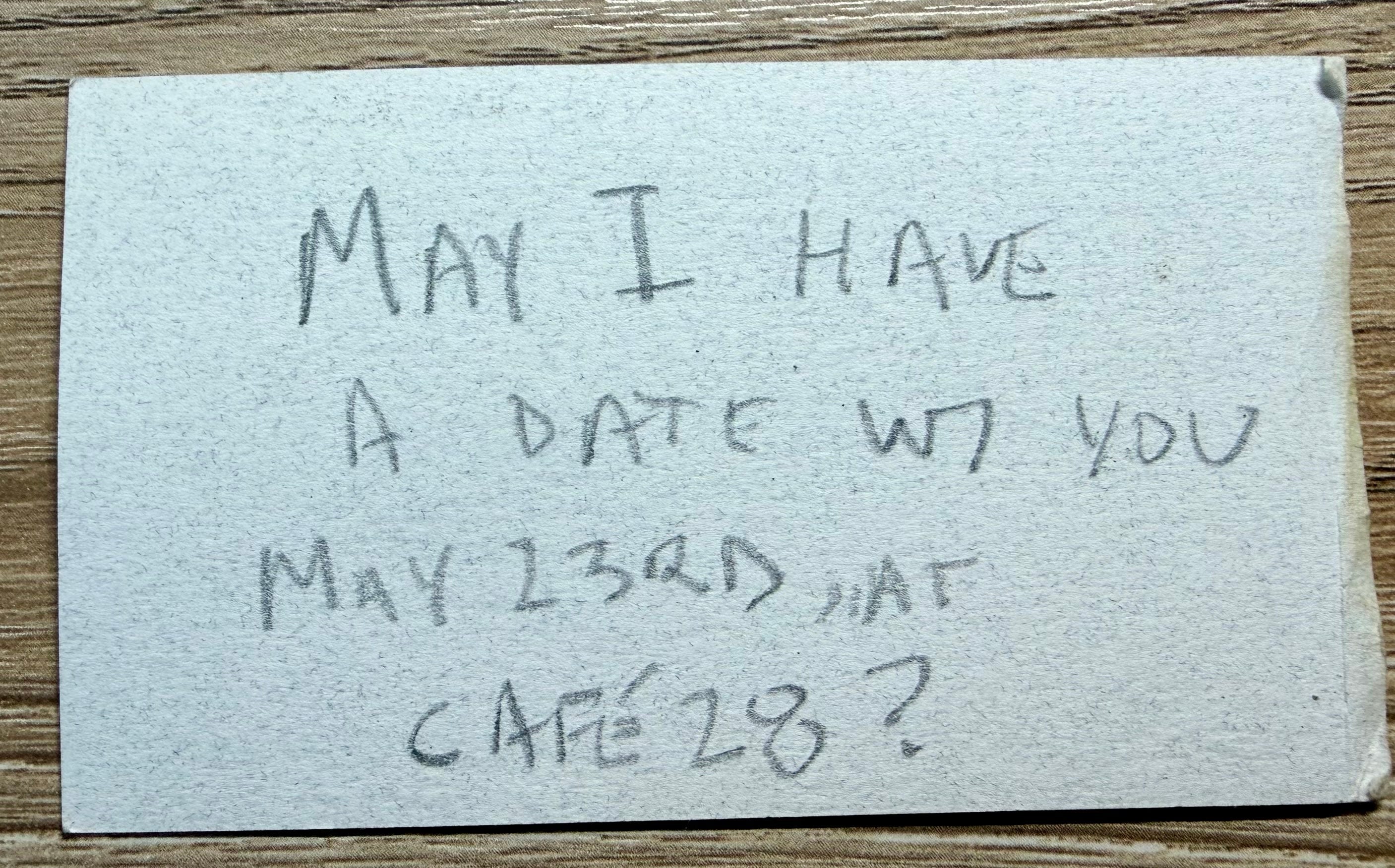
The Card That Started Everything
I still have it—tucked among a small stack of cards, notes, and scraps of paper Ken gave me over the years. Most of them have softened at the edges from handling. This one has too. It’s not fancy. It’s the kind of card you’d find sitting in a little wire holder on a bar, next to the swizzle sticks and matchbooks, meant for nothing more than jotting down a phone number or a tab.
Ken used it for something else.
We were early in whatever we were becoming—not quite a couple yet, but close enough that I already knew I wanted to be one. We were sitting at Scot’s, a little neighborhood bar in Ravenswood that’s long gone now, replaced by something new , the way bars in Chicago tend to be. I don’t recall what we were talking about. I remember the low hum of the room, the particular ease of sitting next to him, the sense that time had quietly rearranged itself around us.
At some point, without much fanfare, he reached over, pulled a card from the holder, and started writing. I watched him do it—the concentration on his face, the small smile he couldn’t quite keep off it—and had no idea what he was up to. Then he slid it across the bar to me.
An invitation. Dinner at Café 28, a Cuban spot down the street, bustling and loud and full of the kind of energy Ken loved. He’d written something close to a question, though it read more like a foregone conclusion. That was Ken.
I said yes, obviously.
What strikes me now, looking at that card, is how small the gesture was and how enormous it turned out to be. He didn’t propose the moment on a napkin scrawled with poetry. He didn’t make some grand declaration. He just used what was in front of him—a bar card, a stub of a pencil—to ask for more time together. And somehow that’s exactly what made it land. It wasn’t a performance. It was just Ken, being direct about wanting something, the same way he’d be direct about most things for the rest of his life.
I think about that a lot now—how the beginning of a relationship gives you a preview of its whole shape, if you’re paying attention. Ken was never someone who waited for the right moment. He made the moment right by simply showing up in it, fully, without hedging. That card is proof of that instinct. He saw something he wanted—more time with me—and he didn’t overthink how to ask for it. He just did.
There’s a particular kind of grief that comes with objects like this. Not the big grief, the kind that flattens you, but a quieter one—the grief of holding something so ordinary that once meant nothing and realizing it now means almost everything. A bar card. A napkin. A parking receipt with a joke written on the back. These things weren’t precious when they were made. They became precious because he’s gone and they’re not.
I’ve kept every card and note Ken ever gave me, even the silly ones, even the ones that don’t say much beyond “pick up milk” or “you looked great tonight.” I used to think I kept them because I was sentimental. Now I think I kept them because some part of me already knew they’d become evidence—proof that a whole life happened, that a person loved me specifically and in his own specific way, in a bar that no longer exists, at a restaurant that no longer exists, in a version of Chicago that only exists now in memory and in boxes like the one where this card lives.
Writing about Ken, I’ve learned, isn’t really about preserving what happened. It’s about noticing what would otherwise dissolve. The big events of our life together—his diagnosis, his death, the soiree, the years after—those stay vivid on their own; they carved themselves into me. But the small things need tending. A card slid across a bar. That needs someone to write it down, or it disappears the way Scot’s did, the way Café 28 did, the way so much of that era of my life has quietly vanished from the map of the city, even if it never left the map of me.
The full story of that night—the bar, the darts, the friend in the Armani suit who never stood a chance—lives in “The Meet Cute,” the opening essay of The Luck We Carry. This card is where it starts. If you want the rest of it, it’s there waiting for you.
Ron Stempkowski is the author of The Luck We Carry: Love, Loss, and the Stories That Shape Us, a memoir-in-essays about learning to move with grief instead of moving on. If this story resonated, you can grab a signed copy—complete with a handwritten note—at ronstempkowski.com, or get your copy wherever books are sold. And if you'd like more stories like this one, join the journey and get them straight in your inbox.