

The text I don’t remember sending
There’s a text in my phone from October 2011 that reads, in its entirety: “Vampires have been here.”
I sent it to my friend Mindy. I don’t remember sending it. I also don’t remember the forty-minute phone call that followed, or the email describing a home-protection spell I’d apparently performed—herbs and intention included—to keep the undead out of my apartment.
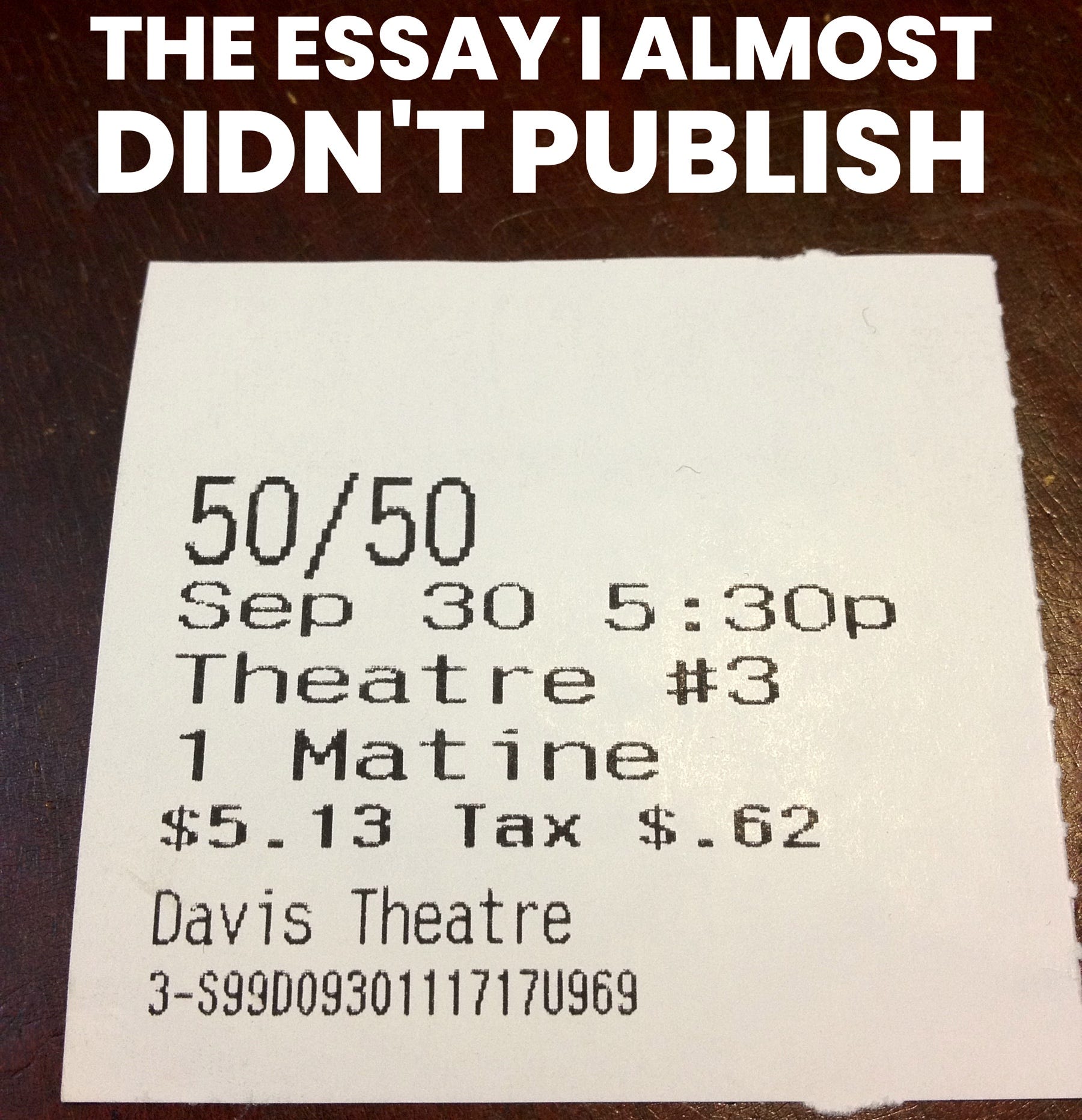
Ken had been gone four months. That night, I walked to the Davis Theater alone to see 50/50, a comedy about a young guy with cancer, because I’d decided I was ready. Then I came home and celebrated my breakthrough with a frozen Red Baron pizza, a few glasses of wine, and an Ambien I had no intention of sleeping through.
You can probably guess how that went.
What I was really protecting
Back then, I treated grief like a test I intended to pass. Before the movie, I texted my sister-in-law, Katie. I posted on Facebook to prove I was “out in the world.” I was performing recovery for an audience—and the one person whose opinion mattered most wasn’t in it anymore.
When I wrote the essay years later, one line surfaced that I still think is the truest thing in it: In my mind, I still represented Ken. If I fell apart, it reflected poorly on him.
That’s what made this story so hard to put in print. A sad story about grief makes you sympathetic. A story about Ambien, Cabernet, and a protection spell makes you a punchline. I wasn’t sure which one I’d be handing readers—or what it would say about the man I loved.
Why it stayed
I kept coming back to Mindy. She didn’t panic, and she didn’t lecture. She humored me that night, and when she visited later, she teased me—maybe I’d just been in tune with otherworldly stuff. I laughed so hard I fell back on the couch.
That laugh did more for me than the movie, the Facebook post, or the triumphant walk home under a pink sky. It was the moment I stopped pretending.
Ken and I spoke humor as a native language. It was how we met, how we fought cancer, how we planned his soirée. Leaving out the most absurd, most humiliating night of my early grief would have meant writing about him in a voice that wasn’t ours.
There was a practical reason, too. Most essays in the book show me coping. This one shows me not coping. Without it, The Luck We Carry would tell a tidier story than the one I lived—and tidy grief helps no one. It just hands people one more standard to fall short of.
If you’re performing okay right now
Here’s what that night taught me: healing can’t be fast-forwarded. Grief doesn’t reward performance. It waits until you’re honest.
So if you’re in the early months, checking boxes to prove you’re fine, try this instead. Open a journal and write down the most absurd thing grief has made you do. Don’t analyze it. Don’t fix it. Just give it a place to live on the page. You may find, as I did, that the laughing comes before the healing—and makes room for it.
And if you’re willing, tell me in the comments. I promise yours can’t top vampires.
The full essay, “Vampires Have Been Here,” is in The Luck We Carry—in print, ebook, and the audiobook I narrated myself. (Yes, I read the vampire part out loud.) You can also borrow it from your library on Libby or Hoopla. More at ronstempkowski.com.
Write on!
Ron Stempkowski is the author of The Luck We Carry: Love, Loss, and the Stories That Shape Us, a memoir-in-essays about learning to move with grief instead of moving on. If this story resonated, you can grab a signed copy—complete with a handwritten note—at ronstempkowski.com, or get your copy wherever books are sold. And if you'd like more stories like this one, join the journey and get them straight in your inbox.