
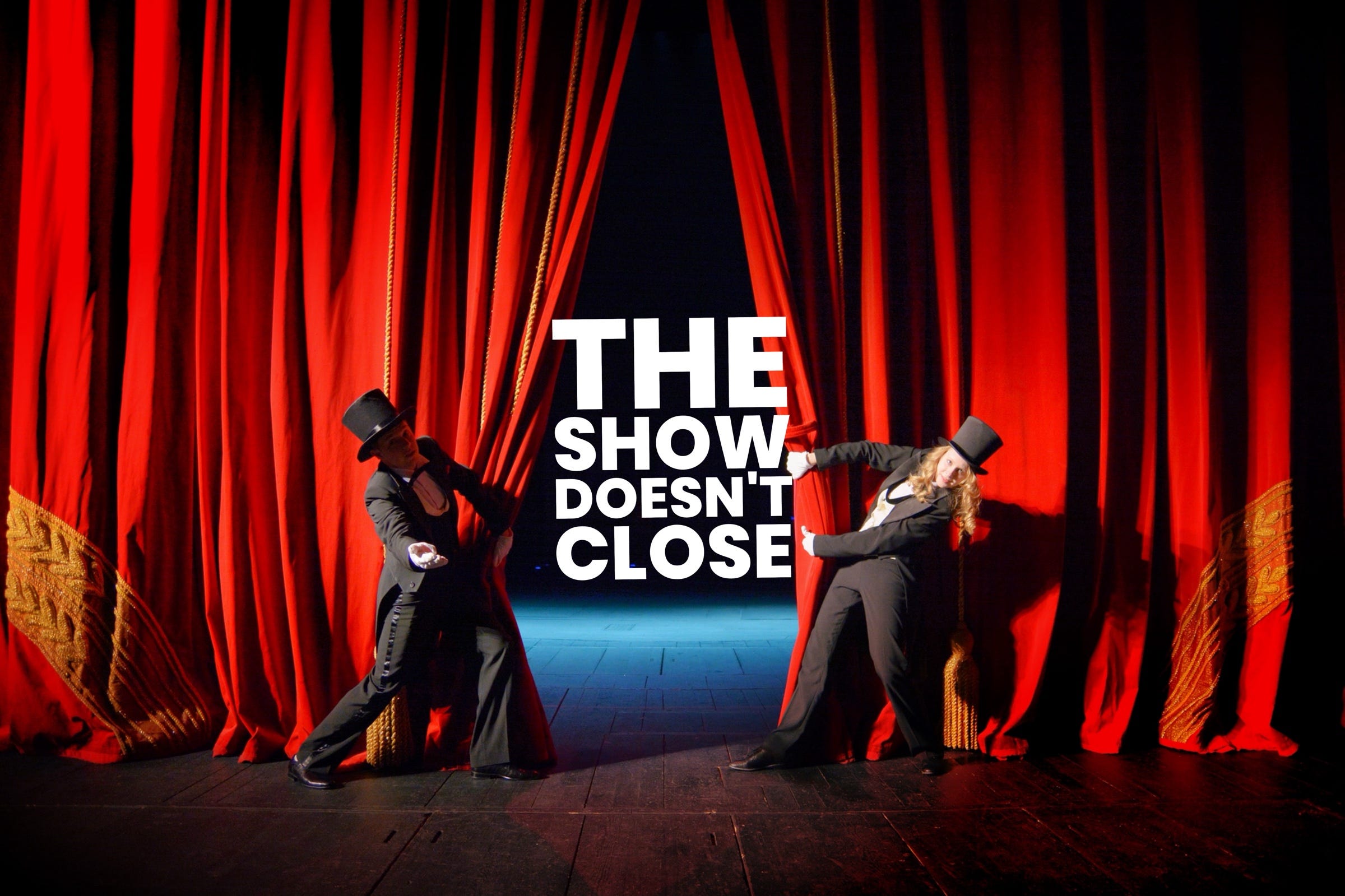
The Show Doesn't Close
I got an email on Friday evening. It was the day after my author event at my library, so I was already flying high. As the week slowed down and Hudson and I could spend a quiet evening on the couch, this email filled me with so many good things.
The email came from a man who was a stranger to me, though it turns out not entirely. He’d donated to kenan derson’s My Foot Left 60th Birthday Fundraiser that I put together in honor of this milestone birthday last year, and I’d written back to thank him, the way I’ve written back to everyone. What I got in return was not a “you’re welcome” and nothing more. What I got was a story.
Years ago, someone took him to see Ken’s one-man show, My Foot Left. He can’t remember her name now—”getting old no fun,” he wrote, which made me laugh out loud alone in my kitchen, because that’s exactly the kind of line Ken would have repeated for a week. But he remembers the show. He remembers standing around afterward, talking to Ken. He remembers being in awe of him.
Then he told me he’d very recently been diagnosed with cancer.
He’d been talking with his sister about Ken’s show—reaching backward, I think, the way we all do when the ground goes out from under us, grabbing for something that once made us feel like the world was survivable. And in the middle of that conversation, he found the link I’d included in my thank-you to watch Ken’s show on my website. He watched it. He sent it to his other sister, hoping it might help her understand what he’s facing.
I’ve read his email probably a dozen times.
Here’s what I keep circling back to.
Ken died in June of 2011. He performed that show ten years before that. The man who wrote to me watched it once, in a theater, a decade ago, and then went on with his life—jobs, dinners, Tuesdays, the whole unremarkable accumulation of a life. And then one day the floor gave way, and of all the things his mind could have reached for, it reached for Ken.
That’s not nothing. That’s not a nice story I’m telling myself to feel better. A man got the worst news of his life and thought about my husband.
Ken had been living with cancer since he was fourteen. He lost his leg to it. He beat it, then beat it again, then beat it again, and then he didn’t. He made a show out of it—a funny one, a show with a pun in the title, because, of course, it had a pun in the title. He built an entire hour out of the thing that was going to kill him and made a room full of strangers laugh about it.
I ran the lights and sound for that show. Badly. I had no business anywhere near a light board. But he asked, and I said yes, because that’s what happened when Ken asked you for something.
I didn’t understand then what we were making. I thought we were putting on a show. I thought it was an evening. It turns out we were building something that would still be doing its job fifteen years after he stopped breathing—something that would find a frightened man in the worst week of his life and hand him a little courage.
People sometimes ask me, gently, whether all this—the writing, the book, the fundraiser, the endless returning to him—is a way of not letting go. Whether at some point the healthy thing is to close the door.
I understand the question. For a long time I asked it of myself, usually at three in the morning.
But I don’t think that’s what’s happening here. Letting go implies there’s something to release, that Ken is a weight I’m carrying up a hill. He isn’t. He’s more like a skill I picked up. He’s in how I talk to people. He’s in the fact that I say yes to things that terrify me. He’s in a stranger’s inbox doing work I had nothing to do with.
I’ve said before that grief isn’t about moving on—it’s about moving with. This is what I mean by that, in the most literal way I can point to. The person is gone. The effect is not. The effect keeps propagating outward, hitting people you’ll never meet, in years you won’t see.
You don’t get to schedule that. You don’t get to know when it’ll happen. All you can do is keep the door open—keep the link up, keep telling the stories, keep answering the emails—so that when someone comes looking, there’s something there to find.
I wrote back to the man who emailed me. I offered him a copy of my book, with a warning attached, because the book goes places he may not want to go right now, and he gets to decide that for himself. Either decision is the right one.
But I keep thinking about his sisters. Two women who never met Ken, who are about to watch a man they’ve never heard of talk about losing his leg, and who might come away understanding their brother a little better.
Fifteen years gone, and he’s still working the room.
Lights up. Sound on.
Watch Ken’s show, My Foot Left.
Ron Stempkowski is the author of The Luck We Carry: Love, Loss, and the Stories That Shape Us, a memoir-in-essays about learning to move with grief instead of moving on. If this story resonated, you can grab a signed copy—complete with a handwritten note—at ronstempkowski.com, or get your copy wherever books are sold. And if you'd like more stories like this one, join the journey and get them straight in your inbox.
Or follow here on Substack…


